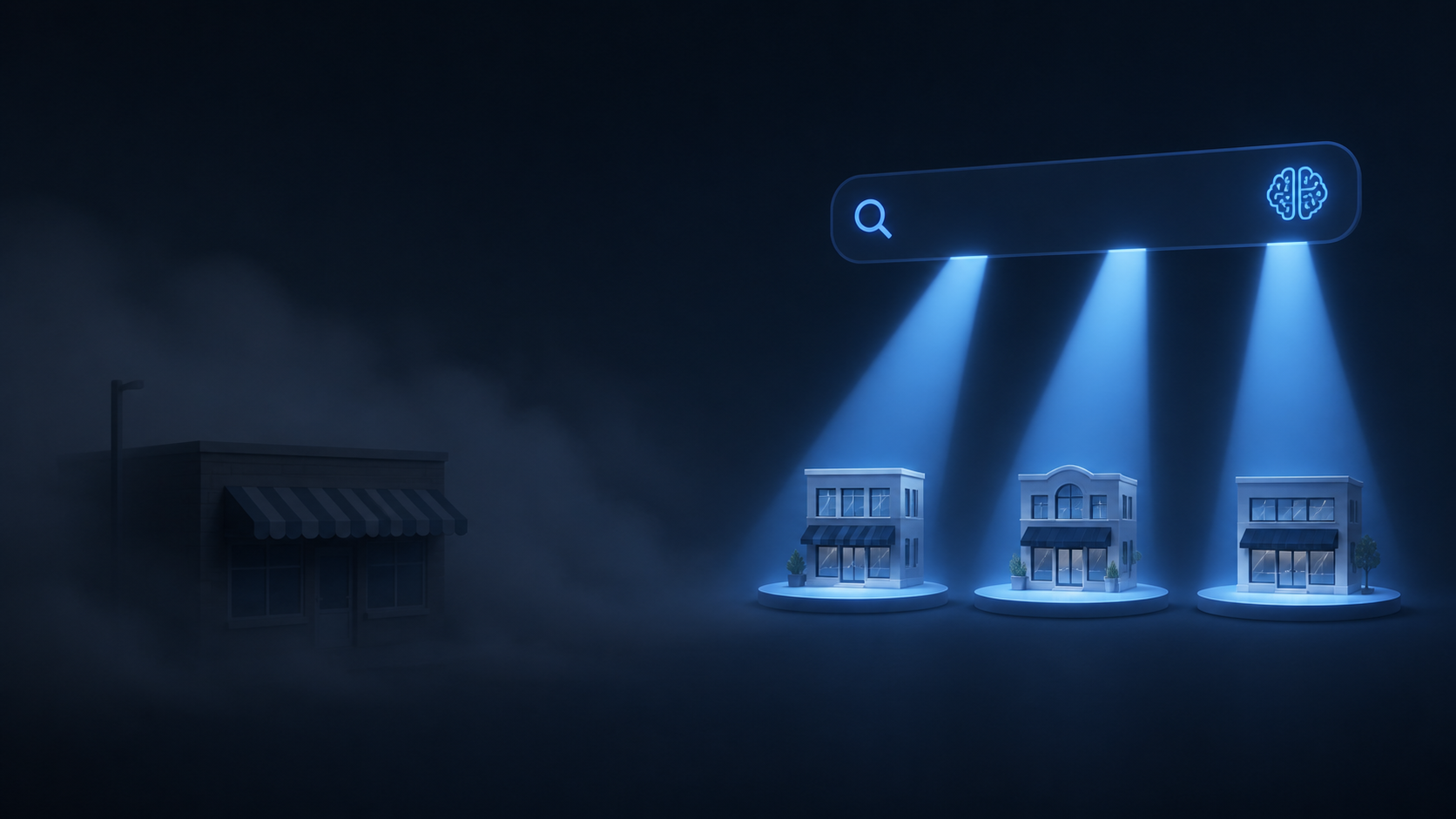
Most businesses don't know they're invisible to AI search. They have a website. They may even rank reasonably well on Google. And they have no idea that when a potential client opens ChatGPT and asks for a recommendation, their name never comes up.
AI visibility and traditional search visibility are not the same thing. A business can be findable on Google and completely absent from every AI tool — and this is more common than most people realize.
Here are the five signs that your practice is invisible to AI search, and what to do about each one.
Sign 1
You can't find yourself when you ask ChatGPT
This is the fastest and most direct test. Open ChatGPT or Perplexity and type: "Can you recommend a [your type of practice] specializing in [your specialty] in [your city]?"
Try three or four variations — different phrasings, different ways of describing your niche. If your name doesn't appear in any of them, you have an AI visibility gap. If it does appear but the information is wrong (wrong specialty, wrong location, outdated), that is also a problem that needs correcting.
The fix
Add a clear entity definition sentence to your homepage and about page. It must state your name, your business name, your specialty, your location, and your target client — in plain language, not marketing language. This is the single fastest way to give AI systems something to work with.
Sign 2
Your website has no structured data
Open your website, right-click, and view the page source. Search for the phrase application/ld+json. If you don't find it, your site has no JSON-LD schema markup — the machine-readable layer that tells AI crawlers exactly what your business is, who runs it, what services you offer, and how to contact you.
Most small business websites have no schema at all. AI systems can still read your prose, but they weight structured data far more reliably. Without it, they're guessing at what you are rather than reading a clear declaration.
The fix
Add Organization or ProfessionalService schema, Person schema for the founder, Service schema for each offering, and FAQPage schema for your FAQ content. This requires technical implementation but is a one-time addition that pays ongoing dividends for AI visibility.
Sign 3
Your FAQ content is hidden behind JavaScript
Many websites use accordion or toggle components for FAQ sections — the kind where you click a question and the answer expands. These are often built in JavaScript, which means the answer text only appears after the page loads and the user clicks. AI crawlers that don't execute JavaScript will see your FAQ questions but not your answers — or may skip the section entirely.
This is a widespread problem and almost no one knows it exists on their site. If your FAQs are important content (and they should be), they need to be in the server-rendered HTML — visible in the page source without any JavaScript execution.
The fix
Either render your FAQ content in static HTML (visible on page load without interaction), or ensure your FAQ content is also captured in FAQPage JSON-LD schema in the page head. Schema-marked FAQ content is machine-readable regardless of how the visible page renders.
Sign 4
Your credentials are inconsistent across sources
Compare how your credentials appear across: your own website, your Psychology Today profile (if you have one), your Google Business listing, LinkedIn, and any other professional directory where you're listed.
If your degree is listed differently in different places ("M.A. in Psychology" vs. "Master's in Psychology" vs. "graduate degree in psychology"), if your license type varies, if your specialty description changes from one platform to another — AI systems register this as inconsistency. And inconsistency is a trust signal they tend to penalize.
AI tools are building a picture of who you are from multiple sources. When the sources contradict each other, the picture is blurry. A blurry picture is less likely to generate a recommendation.
The fix
Standardize your credential statements across every platform. Choose one exact form for your degree name (with the institution), your license type (with the state and license number), your specialty, and your location — and use that exact form everywhere.
Sign 5
You have no content for AI to cite or quote
AI tools prefer to recommend practitioners and businesses they can cite. A recommendation backed by citable content — a blog post, an FAQ answer, a detailed service description — is more credible and more complete than a recommendation with nothing to reference.
If your website is a homepage with a hero image, a brief bio, and a contact form, there is almost nothing for an AI tool to quote or link to. You may still appear in AI results, but you will appear generically — and a competitor with three well-written articles about their specialty will appear more specifically, more confidently, and more often.
The fix
Write two or three specific, useful pieces about your specialty. Not marketing copy — actual information. What your specialty involves, who it helps, how you approach it, what clients can expect. The more specific and useful the content, the more an AI tool can cite it in a recommendation.
"AI visibility is not about being found. It is about being legible — giving AI systems enough clear, consistent, specific information to confidently recommend you."
The good news
Every one of these gaps is fixable. None requires a complete website rebuild or a large ongoing marketing budget. The changes are specific, one-time improvements that create lasting visibility.
The businesses that address these gaps now are doing so before their competitors catch on. That window of competitive advantage is real — and it is temporary.
Not sure how many of these apply to your practice?
A free 15-minute call to audit your current AI visibility and identify which gaps to close first.
Book Your Free Call →Questions about AI search visibility
How do I check if my business is visible on ChatGPT?
Open ChatGPT and ask it to recommend a business like yours in your location and specialty. Try at least three different phrasings — some people ask in question form, others describe what they're looking for. If your name doesn't appear in any variation, you have an AI visibility gap. Also search your business name directly and see how ChatGPT describes you.
What is JSON-LD schema and why does it matter for AI search?
JSON-LD schema is machine-readable markup embedded in your website's code that tells AI crawlers specifically what your business is, who runs it, what services you offer, and how to contact you. Unlike the visible text on your page, which AI must interpret, schema is structured data written specifically to be read by machines. AI tools weight schema-marked information more reliably than prose — making it one of the highest-impact technical improvements for AI visibility.
Why doesn't my business show up when I search for it on Perplexity?
The most common reasons a business doesn't appear in Perplexity results are: no clear entity definition on the website (AI can't categorize what you are), inconsistent information across sources (AI treats inconsistency as unreliability), no structured data or schema markup, and no content for AI to cite or quote. Perplexity pulls from live web searches and tends to surface businesses that have clear, consistent, well-structured online presence across multiple sources.
How long does it take to become visible to AI search after making changes?
Initial visibility improvements typically appear within 4 to 8 weeks for Perplexity and Google AI Overviews, which pull from more frequently updated sources. ChatGPT tends to reflect changes more slowly, often 2 to 3 months after implementation, as it depends on Bing's indexing cycle. Full, consistent AI visibility across multiple tools and query types generally builds over 3 to 6 months.