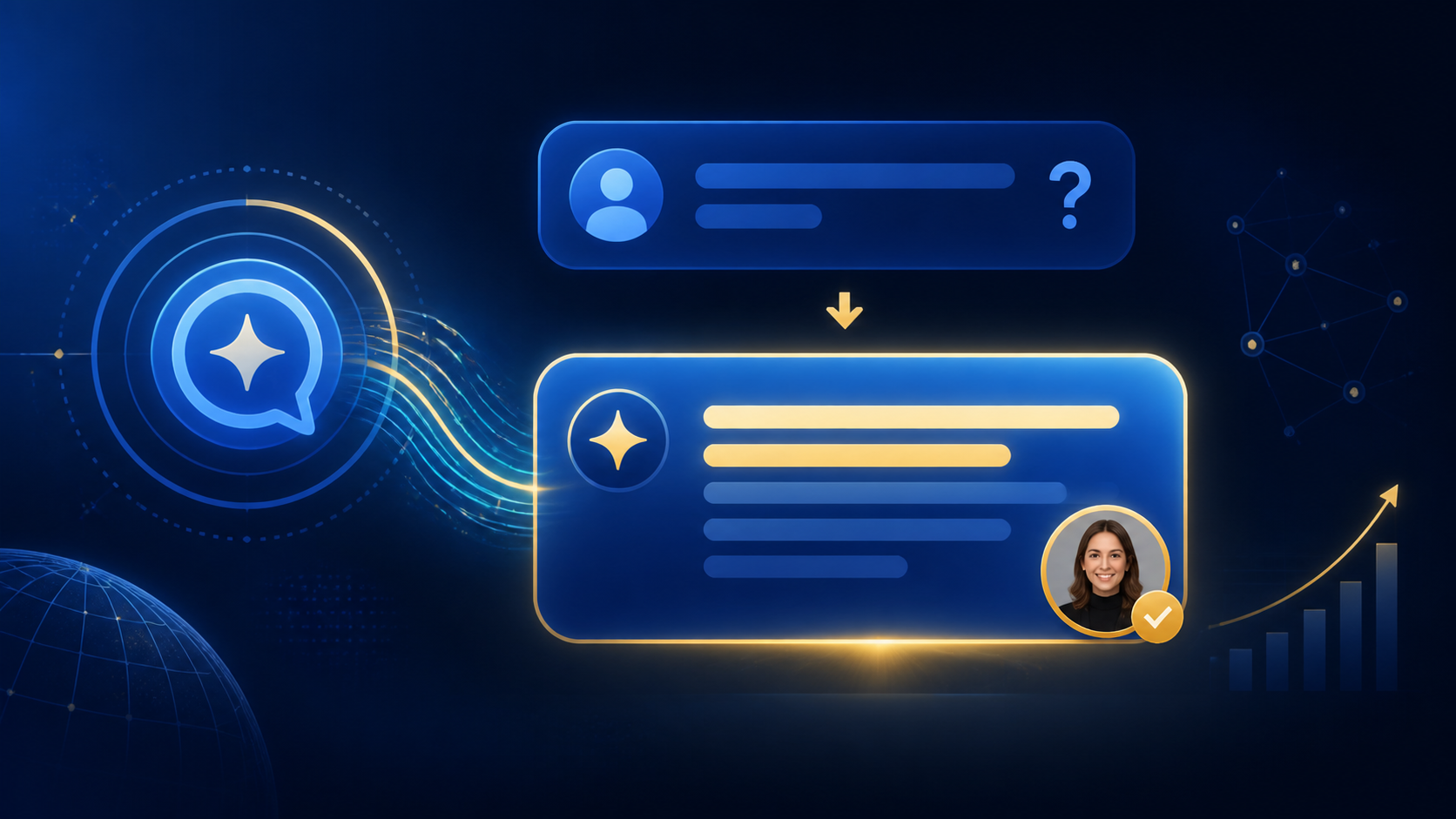
Your next client is not opening Google and scrolling through links. They are typing a question into ChatGPT. They are asking Perplexity. They are getting a recommendation from Google before they ever see a website.
And that recommendation has someone's name in it.
Answer Engine Optimization — AEO — is the practice of making sure that name is yours.
What is Answer Engine Optimization (AEO)?
Answer Engine Optimization (AEO) is the practice of structuring your website content and online presence so that AI tools recommend your business when people ask questions relevant to your services.
Traditional search engines like Google show you a list of links and let you choose. AI tools — ChatGPT, Perplexity, Claude, Google AI Overviews — give you a direct answer. They pick one. They cite someone. They recommend a name.
AEO is how you become that name.
"AEO doesn't optimize for a ranking position. It optimizes for a recommendation — a fundamentally different goal that requires a fundamentally different approach."
How is AEO different from SEO?
SEO (Search Engine Optimization) has been the dominant approach to online visibility for 25 years. It works by helping your pages rank highly in a list of search results — getting to page one of Google, earning backlinks, targeting keywords.
AEO targets something different: the moment when an AI system generates a response. That moment is governed by different signals entirely.
| Traditional SEO | Answer Engine Optimization (AEO) | |
|---|---|---|
| Goal | Rank in a list of links | Be the recommended answer |
| Platform | Google, Bing search results | ChatGPT, Perplexity, Claude, Google AI Overviews |
| Key signals | Keywords, backlinks, page speed, domain authority | Entity clarity, structured data, FAQ content, cited expertise, consistent credentials |
| Content format | Keyword-optimized pages | Clear entity definitions, natural-language Q&A, citable factual claims |
| Result | Blue link on a results page | Named recommendation in an AI-generated answer |
Both matter. But most small businesses and private practices have invested years in SEO and have invested nothing in AEO — because AEO barely existed two years ago. That gap is the opportunity.
What is GEO, and how is it related?
You may also hear the term Generative Engine Optimization (GEO). GEO is closely related to AEO and the two terms are often used interchangeably.
If there's a useful distinction: AEO focuses specifically on appearing in direct answers to questions. GEO focuses more broadly on how your brand is represented in AI-generated content — including summaries, comparisons, topic overviews, and unsolicited mentions.
Together, AEO and GEO describe the full landscape of optimizing for AI systems rather than traditional search engines. When I work with clients, I address both.
Why does this matter right now?
The shift is already happening. According to research from BrightEdge and Search Engine Land, Google AI Overviews now appear before traditional link results in more than 25% of all searches. ChatGPT and Perplexity together handle over a billion queries every month.
People are using AI to find therapists, coaches, consultants, and specialists. They are asking questions like:
- "Who is a good therapist for burnout in [city]?"
- "What type of coach helps with work-life balance?"
- "Can you recommend a mental health consultant who works with executives?"
The AI systems answering these questions pull from what exists on the web — your website, your professional listings, the language you use to describe yourself and your work. If your online presence was built for traditional search, it may be largely invisible to AI.
What does AEO actually involve?
At a practical level, AEO involves several categories of work:
1. Entity clarity
AI systems need to answer "what is this organization?" with a noun. If your website doesn't have a plain-language sentence that defines who you are, what you offer, and who it's for — AI tools will either guess or skip you. AEO starts with making that definition explicit and consistent across your site.
2. Structured data (Schema markup)
JSON-LD schema markup is machine-readable metadata embedded in your website that tells AI crawlers specifically what you are, who you are, what you offer, and what credentials you hold. It's invisible on the page but highly readable by AI systems. Adding Organization, Person, Service, and FAQPage schema to your site is one of the highest-leverage AEO moves available.
3. FAQ content in natural search language
AI tools frequently pull directly from FAQ content on websites. The key is that FAQ questions must be written the way someone actually types into ChatGPT — not the way a business owner phrases their talking points. "How long does burnout recovery take?" will be indexed. "What distinguishes our evidence-based approach?" will not.
4. Consistent, specific credentials
AI systems weight cited expertise heavily. Your credentials need to be specific (degree names, institutions, license numbers), consistent across every page, and explicitly linked to your current role. Vague or inconsistent credentials are a trust signal to AI — and not a good one.
5. Citations and references
AI tools prefer content that cites authoritative sources. If your work draws on research — therapeutic frameworks, clinical literature, industry studies — naming and linking to those sources makes your content more citable and more credible to AI systems.
Do therapists specifically need AEO?
Yes — and the timing is particularly urgent for therapists, coaches, and mental health practitioners.
The people who most need mental health support are increasingly searching for it through AI tools. They may be too overwhelmed to scroll through search results. They may prefer the conversational format of ChatGPT. They may use Perplexity specifically because it cites sources and feels more trustworthy than Google.
When they ask "who is a therapist who specializes in anxiety in [city]?" or "what kind of therapist helps high-achieving women with burnout?" — AI gives them a name. AEO is how you become that name rather than a competitor.
Psychology Today listings, Healthgrades profiles, and a well-optimized website remain important. AEO is not a replacement for those — it is the layer that makes AI systems able to find and recommend everything you've already built.
How long does AEO take to work?
In my experience working with clients, initial visibility improvements in Perplexity and Google AI Overviews typically appear within 4 to 8 weeks of implementation. ChatGPT tends to follow several weeks later as Bing indexes the changes (ChatGPT's browse feature pulls from Bing's index).
Full traction — consistent, reliable appearance across multiple AI tools for multiple relevant queries — builds over 3 to 6 months as the content strategy compounds. Unlike paid advertising, this visibility does not stop when a budget runs out.
Not sure where you currently stand with AI search?
Book a free 15-minute call. I'll tell you exactly where you appear — and where you don't — across ChatGPT, Perplexity, and Google AI Overviews.
Book Your Free Call →Frequently asked questions about AEO
What is Answer Engine Optimization (AEO)?
Answer Engine Optimization (AEO) is the practice of structuring your website content and online presence so that AI tools — like ChatGPT, Perplexity, Claude, and Google AI Overviews — recommend your business when people ask questions relevant to your services. Unlike traditional SEO, which focuses on ranking in a list of links, AEO focuses on becoming the cited answer.
How is AEO different from SEO?
SEO (Search Engine Optimization) focuses on ranking highly in a list of search results — getting your page to appear on the first page of Google. AEO focuses on becoming the answer AI systems give directly, before any links are shown. The signals are different: AEO prioritizes clear entity definitions, structured data, FAQ content, and cited expertise rather than keyword density and backlinks. Most businesses need both, but AEO is the newer and currently less competitive layer.
Do therapists and private practice owners need AEO?
Yes. Clients increasingly use AI tools like ChatGPT and Perplexity to find therapists and mental health support. When someone asks "who is a good therapist in [city]" or "what kind of therapist helps with burnout," AI tools generate a recommendation. AEO is the practice of making sure your name — not a competitor's — is the one they recommend.
What is Generative Engine Optimization (GEO)?
Generative Engine Optimization (GEO) is closely related to AEO. While AEO focuses on structured answers to specific questions, GEO focuses more broadly on how your brand appears in AI-generated content — including summaries, comparisons, and recommendations. Together, AEO and GEO describe the full practice of optimizing for AI-generated search results rather than traditional link-based search.
Can I do AEO myself, or do I need a professional?
Some AEO basics — like writing clearer entity language on your About page or adding FAQ content in natural language — are things a motivated business owner can do. The more technical elements, like JSON-LD schema markup and structured data implementation, typically require professional help. The AI visibility package at Tami Stewart Consults is designed for business owners who want everything done for them without needing to learn the technical side.