
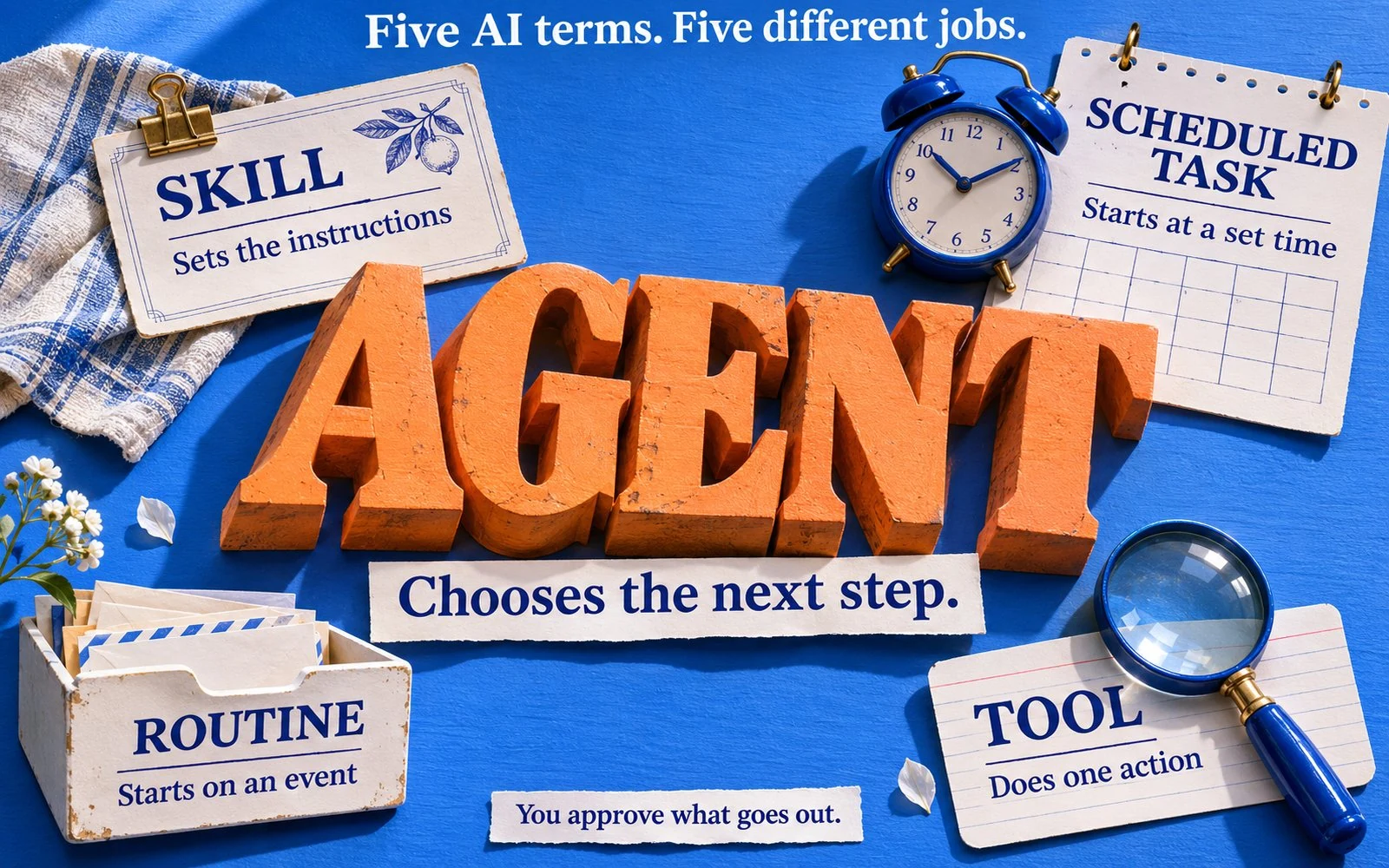
You asked for an agent. Someone sold you an automation. Someone else called it a skill. A third person said it was just a tool.
Same word soup. Different things. Here is the sorting.
Tool
A tool does one thing when something tells it to. A calculator. A calendar. A spreadsheet. In AI, a tool is something the AI can pick up and use: search the web, read a file, look up a customer, send an email.
The tool does not decide anything. It waits.
Skill
A skill is a written set of instructions the AI follows for one kind of job. How I write a follow-up. How I clean a lead list. How an invoice reminder should sound.
Think of a recipe card. It does not cook anything by itself. It makes the same job come out the same way every time.
Scheduled task
A scheduled task runs when the clock says so. Every weekday at 7 AM. Every Friday at 4. It does not decide whether to start. The time decides.
Routine
A routine is a saved set of steps that runs when something triggers it. A new lead fills out your form, and the steps run. Same steps, every time.
People use "routine" and "scheduled task" for nearly the same thing. I use scheduled task when a clock starts it and routine when an event starts it. Both answer one question: when does this run?
Agent
An agent is the AI doing a job with judgment. You give it a goal, not a script. It looks at what came in, decides which tools to use, does the steps, checks its own work, and stops when something needs a person.
Here is the difference that matters. A routine follows the same steps every time. An agent decides the steps.
Agentic AI
Agentic describes AI that acts toward a goal instead of only answering a question. Chat answers. Agentic does. It plans, uses tools, takes steps, and checks the result.
It is a scale, not a switch. A tool is not agentic. A routine barely is. A good agent is. How far up the scale you go depends on how much you trust the job to run without you.
For anything that touches a customer, money, or private client information, I keep a person at the end. Routine work moves through the system. Judgment stays with you.
How they fit together
An agent uses tools, follows skills, and can start from a routine or a schedule.
Take a lead follow-up agent. The skill says how I write a follow-up. The tools are your inbox and your CRM. The routine starts it when a new lead arrives. The agent decides who needs a nudge and drafts it. A person approves before anything goes out.
Which one does your business need?
If the steps never change, you need a routine or a scheduled task. If the writing has to come out consistent, you need a skill. If the job needs judgment every time, you need an agent.
Most businesses need a mix. And more often than people expect, the answer is the smallest one.
See them working
I have built agents for the jobs that repeat in most businesses: answering leads, checking invoices, triaging calls, cleaning a list. Each one is on the Agent Lab with a real run on sample data. You can pick one of mine, or we build one around your business.
Where can I help you? Book a free 20-minute call and tell me which job keeps landing on you.